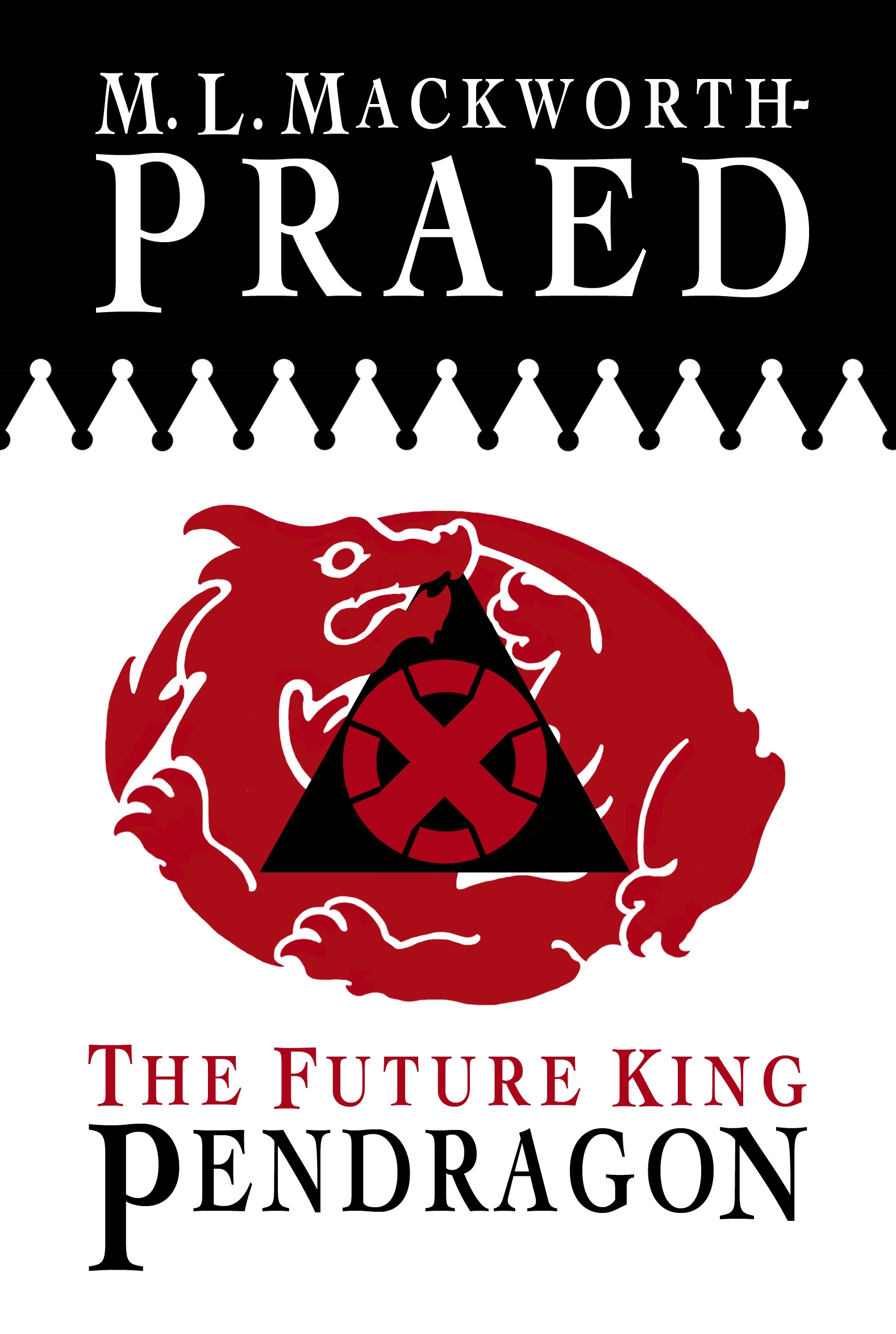
Cover reveal – Pendragon

So I finally got my act together and made the final tweaks on the cover for my upcoming release, Pendragon.

Not to say that the cover is finished. No doubt I’ll fiddle with a few small things when I get to the formatting and publishing stage, but this is what it’s going to look like.

The eye motif of Logres 2 has consumed the white space around the New Moral symbol, and has evolved into the form of a dragon (Pendragon), which is wrapping around the New National eye-cross and consuming the space around it in a storm-like fashion. (Plenty of clues what’s coming up in Pendragon in that alone.)

Every time I think I’m going to do a redesign of my book covers (or pay someone more talented than myself to do it for me) I come right back around to loving them – the simplicity stands out, and is separated from any current book-cover-art trends. I’m not delusional, however – the covers do work better in paperback than on the screen, as the white space is often lost in the white space of the internet, but never mind.

In other news I’m trying to figure out if my (sudden) desire to go and study cosmology is enough to pull me through going back to university to do a physics degree. Plan A, make enough money from writing The Future King series to do it for a living; Plan B, continue it as a hobby and work to pay the bills. The thought of continuing to coast through admin role after admin role for the rest of my working life, however, is no longer so appealing. I saw a MA in cosmology at the KU Leuven which looks AMAZING, and if I’m going to have to work on something other than TFK, then I’d rather it be something related to that. But to do THAT I need a degree in physics, so…

Twenty hours a week around a full time job, children, writing, (and I’d also like to learn to play the piano) sounds a little unachievable. But then I’m already a workaholic for TFK anyway. The idea of learning something completely new to give my arts-and-humanities-leaning brain a workout also sounds appealing to me. (I feel I should mention however that I just about scraped a C in my GCSE maths.)

This week I finally finished editing my first draft of Pendragon, which left me sitting at about 320,000 words. Too fat to publish, and I wasn’t planning to split this volume into two. I’m now butchering it in Pages and slicing whole scenes – last word count was 309,000. I think I can get it to just under 300,000, and then it’ll be another paper edit, and more slicing and streamlining. Whether or not I’ll get Pendragon out later this year, or early next year, is not yet decided. Did I mention I created the cover for Pendragon in a 20-year old version of photoshop on a broken laptop with no keyboard and a dodgy mousepad? Can you tell?

I already know what the cover will look like for the next book in The Future King series, Excalibur (three guesses? It involves a sword).

Thank you to everyone who’s following my writing journey – I hope to have Pendragon released for you soon!

10 things I have learned whilst proof reading

  1. Unless you are a professional proof reader, it is inevitable that you will always miss something (but then I wonder, do professional proof readers miss things too?).
  2. It is surprising how one can read a manuscript multiple times, catching double-spaces, incorrectly formatted dashes and dots, missing words, extra words, and yet on the hundredth read discover an entirely overlooked error – in my case missing speech marks at the end of some lines.
  3. Relying on speech & dictation to catch things for you is a very useful method (particularly for spotting typos) – but it is not to be relied upon 100%. Only yesterday my reader Alex decided to add ‘that’ into my sentence. Clearly he thought the sentence was better with an extra demonstrative pronoun.
  4. A formatted manuscript is much easier to spot mistakes in than a non-formatted manuscript. I suppose it’s the increased space between lines, the fewer words per page, or something.
  5. Fewer words per page and a smaller page size means that you’ll have twice as many pages to proof read, yet somehow because of this the whole task seems to go faster (120 pages per day! Woo!).
  6. Knowing when to stop proof reading is a real issue. How many times do you go through it? With each change lies the potential for fresh mistakes. What if you have a blind spot to the difference between her and his? You meant his, but you typed her. You might not see you typed her until your book is already in print.
  7. I suppose the above is why I am asking friends and family to read through my manuscript for me (trusting, of course, in their superior ability to sense typos in a sentence – much like those who sense a formidable, horrible disruption when one digit is off in pi – can you? 3.141592653589793238462643383279
    50288419716939937510582097494459230781640628620899862803482
    534211706798214808651328230664709384460955058223172535940812
    848111745028410270193852110555964462294895492038196442881097
    56659334461284756482337867831652712019091456485).
  8. The fear of releasing one of those books that we’ve all come across – when you’re on page seven, and a word is missing, or wrong, or repeated – is quite possibly irrational, but also very real.
  9. Don’t try to proof read if you’re tired or hungry. Unless you’re in the right frame of mind whilst reading, you will approach the end of the chapter with the feeling you have not done as well as you could have, and then resign yourself to combing through the same pages again later, when you’re feeling a little less useless.
  10. With all the above taken into consideration, a novel can always be amended to fix any overlooked errors. After all, we all know that’s what editions are really for, right?