The Future King: Logres – book cover release!

TFKBookCoverMLMP2015
The Future King: Logres is due to be released in October of this year. Keep checking back for teasers and confirmation of a release date.

So today I am finally ready to post up the above design. This is my novel, this is my my book cover: this is what it looks like. It’s simple, it’s clean, and it’s a great start to the look and feel of the rest of the series.

The name of the series, The Future King, is born from the promise of King Arthur’s messianic return to save the country despite his downfall at the end of the original legends. Logres is the scene in which this second coming is set: the secondary school at which fifteen-year-old Gwenhwyfar Taliesin starts after moving from Swansea with her affluent parents. It is 2052, and the gap between rich and poor has never been wider. Immigrants are persecuted and dubbed ‘illegals’ while day-to-day life is becoming increasingly monitored: just another year under George Milton and his ruling party, New National.

Things are going well for the release of The Future King: Logres – the book has been fully formatted and I am just perfecting my final draft. It will then be sent off to my proof-readers (very kind friends and family who don’t mind checking for errors). I’m greatly looking forward to seeing Logres printed and in final book format – my full book design is waiting patiently in photoshop as a psd file for my confirmed spine width. Then I just need to write a blurb.

Feel free to let me know what you think of the chosen design if you’d like to leave a comment. It’s back to editing, here, but keep checking back for more news, updates and teasers in the weeks to come!

10 things I have learned whilst making a book cover

  1. Pre-existing book covers are your friend. Look at them, examine them and focus on studying books in your genre, but don’t be too disappointed if your self-publishing platform doesn’t support the trim size you inevitably fall in love with as a result (five by seven, five by seven!).
  2. Make sure the cover correlates with the interior feel of the actual novel (and then dance about celebrating your own brilliance when you think of something that looks really cool).
  3. Having twenty layers live at once in Photoshop will destroy your computer. No, really. The fan on mine has just… died, or something.
  4. After spending four hours trying to align font at the bottom of your page to font at the top of your page, your eyes will go funny and everything will look wonky anyway.
  5. The longer you stare at the block colour red, the more it begins to look like some whacky gradient.
  6. Apparently due to variations in book binding the artwork for the cover will sometimes end up on the spine, and spine on the cover. You will be advised to avoid sharp lines and complex patterns, so naturally use them anyway.
  7. You should (and probably will) print out your book cover and wrap it around some other less important novel just to see what it looks like on a bookshelf (mighty good, I tell you).
  8. An actual, real life plastic ruler can be very helpful when determining layout spacing on your screen for the less technically gifted of us.
  9. Asking (non-graphic designery) people their opinion on your artwork can be confusing. Just focus on the things they agree on, and ignore anything they don’t.
  10. Making a book on a template before you have your final page count is just asking for trouble. You think you’re finished, then a last-minute cut adds or subtracts a page or two. New spine thickness, new document! Yeah!

Part-time post

By now you’ve probably sussed the title of this blog in that I’ve been absent for a couple of days. I’m not yet sure at which frequency I will ultimately end up posting at, but as long as it’s higher than zero I feel I will be doing well. I’ve been up to a lot in the past few days, though mostly it’s been the same thing, cutting my novel on paper.

As of yet I’ve no idea how many words I’ve lost, but the experience in itself has been surprising. How, after roughly five re-writes and several more proof-reads are there still errors? Not many, granted, but one missed missing word can be catastrophic enough if not caught – as can typos, punctuation errors – and even worse: whole scenes that just don’t fit with the rest of the narrative.

It’s easy to end up with a scene that doesn’t work, particularly when said scene was written afterwards and inserted in the hopes it would further develop a character. The scene in question continues something that has already been resolved, yet expands the issues raised and gives a good relationship boost to the two main protagonists. As a result it must either be cut or re-written (we’ll see how the word count goes). Three people missed it when reading through it, though one reader said they were just too caught up in the storyline to even notice the discrepancy. I suppose that’s why people hire editors.

And so begins the three-day process (hopefully!) of trawling through my corrections in Word. Each revision always risks new mistakes, much like some sort of wordy vicious cycle, but then I suppose that’s why people hire proof-readers, too. Not something that’s doable without a substantial budget, so I’ll have to make do.

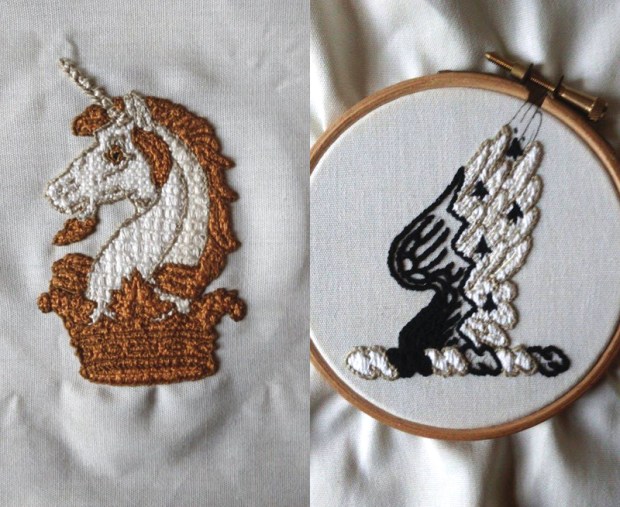
In other news I have been embroidering a bit this week, my family crest for the name Mackworth (a raven’s wing with ermine, see below). This goes with the unicorn head for Praed, though often it’s only the unicorn head which is depicted for both. Heraldry is another one of my interests, and I look forward to seeing these two finished and framed next to one another.

Crests for Mackworth-Praed, embroidered by M. L. Mackworth-Praed, 2015.
Crests for Mackworth-Praed, embroidered by M. L. Mackworth-Praed, 2015. Embroidered with two stitch types: stem stitch and couching, the stitch types used for the Bayeux Tapestry.

That’s all for now, it’s time to steam through this edit. Hopefully afterwards I’ll have a more realistic page count and can finish formatting and start uploading to Amazon. I will keep you updated on any progress. Until the next part-time post!

The Knights of the Round Table

“His broad clear brow in sunlight glow’d;
On burnish’d hooves his war-horse trode;
From underneath his helmet flow’d
His coal-black curls as on he rode,
As he rode down from Camelot.
From the bank and from the river
He flash’d into the crystal mirror,
‘Tirra lirra, tirra lirra:’
Sang Sir Lancelot.”

– The Lady of Shalott (1832) by Alfred, Lord Tennyson

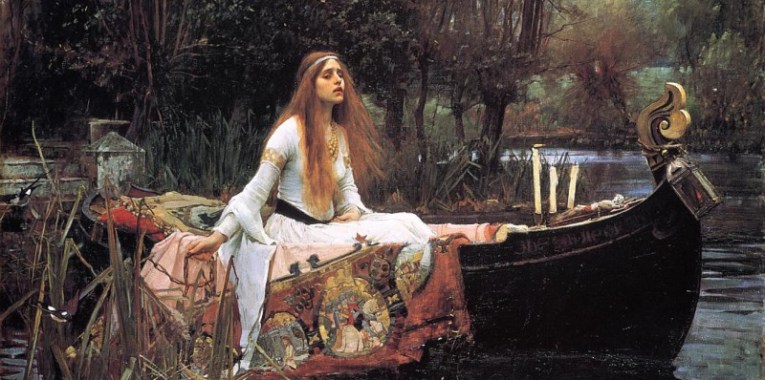
Arthur. Merlin. Camelot. The legends of King Arthur and his knights are known in some form or another to the majority of the population, and have repeatedly been reinvented in television, film, and the written word. Personally I cannot pin-point my first encounter the legends, but assume it must have been through an older text, because when I first saw Jerry Zucker’s First Knight (1995), I thought they had misspelt Sir Lancelot (as far as I was concerned at the time, it should have been Sir Launcelot). It wasn’t until college that I delved deeper into the legends, after reencountering them through my studies of the Pre-Raphaelites (in particular John William Waterhouse’s The Lady of Shalott (1888)). First I read Tennyson’s accompanying poem (quoted above), and then I purchased Le Morte d’Arthur from my local Waterstones. After hunting the same store for King Arthur related books, I soon discovered my all-time favourites: Marion Zimmer Bradley’s The Mists of Avalon, Bernard Cornwell’s Warlord Chronicles, and T. H. White’s The Once and Future King. Each author’s interpretation of the legends is, of course, birthed from the same origins. But each is fundamentally and absolutely different.

What is it about the legends of King Arthur that is so expansive? You could tell a hundred authors or more to retell the legends in their own words, and no two versions would be remotely the same (unless of course they were talking, and intending to be the same). Of course, a writer’s different styles and preferences would affect any such project. But in the case of King Arthur, I think the legend’s richness is compound in the inevitable differences. There are dozens of stories within the framework offered, and hundreds of subplots countable from that. It is just so complex. Who do you focus on? Which stories do you tell? The list of the Knights of the Round Table at its most expansive runs to more than 150. The love stories are ever-changing and entwined. The quests are endless – the Holy Grail, the Questing Beast – authors need only take their pick.

My interpretation of the legends of King Arthur evolved from my own experiences and interests in life, metamorphosing into a hybrid of contemporary concerns and the raw essences of the myths. This modern reflection of the myths is set to span the arc of Arthur’s rise to power in a futuristic depiction of Britain. Book one has been written, and I have read Createspace’s lengthy user agreement and deemed it satisfactory. I am looking into the particulars of self-publishing, such as how to format a book and how to design your own cover. I can’t afford a graphic designer or a proof-reader or editor, so I (like many others) will be taking a risk and doing all of the work myself.

Perhaps it is a good sign that after all these years I am still not bored by my idea. I still believe in the concept, I still love the characters. I can re-read the first and last fifty pages again and again, and still find them interesting. Many stories of King Arthur hint at Arthur and Merlin retiring for the long sleep – destined to reawaken when Britain needs them most. I think this perhaps is one of the most attractive concepts in the legends – the promise of hope in the dark days to come.

The long haul.

When I first started my novel back in 2011, the first draft took me a total of six weeks. I had an idea I’d been chewing over since 2007 with one short attempt to turn it into something physical, but then, at the end of my university semester and with a long summer ahead of me, I dove in head-first and just wrote it.

How long is too long when working over an idea? Us artists are creatures of detail, and such proficiency bestows upon us great patience. Sometimes we get drawn into an idea too much, and find ourselves unwilling (or unable) to comprehend an end. Does such a predicament matter, however, when one is so engaged by an idea that it feels as if every day spent working on it is entirely new? Often it passes without notice; the minutes become hours, the hours whole days. You work, and you forget to eat, drink or sleep. You’re so enthralled by what you are doing that the pang of hunger or stiffness brought about by an uncomfortable chair can do nothing to hinder you.

I have done several drafts of my book up to date, and naturally each revision was packaged with the exclamation, ‘Eureka! This is it!’ and sent off to the most promising literary agents. Of course with each submission came a rejection, and I would soon succumb to the age-old problem of returning to your own work with eyes changed by time. It happened when I painstakingly drew Christopher Columbus’ ship when I was four. Then, it was a masterpiece! Now, not so much.

A novel, unlike a sketch or drawing however can be edited, and so I embarked on making it perfect. Each time shorter or longer, and every time (I would like to think) better, stronger. My very fast draft in 2011 was written with the estimate I would then spend about six months editing. Then it would be ready to publish. Of course.

Four years later I am on my… fourth? real, complete restructure and rewrite. I’ve read the blogs, I’ve seen the news. I know that most people’s first projects get shelved until they are rich or famous enough through other works to get them published retrospectively. Does it change things if I say that this isn’t my first attempt at a novel? My first idea has been shelved without much input, perhaps for another day.

I think, however, we all have some idea of what works and what doesn’t. We all read and we all have things which we can compare our own work to. My latest draft, I have decided, is going to be my last. I will make sure I am happy with it, and then I will move on. These days debut authors’ options are expanded by the possibility of self-publishing. Now our first novels can be released into the market as they are, as we intended.

This project is a series, or it will be when I’m done with it. After researching the available avenues self-publishing is becoming a real consideration. I have had interest for my idea from two reputable agents, including full manuscript requests and even one revise and resubmit. Unfortunately, it wasn’t for them. But I now have a better book as a result, and am less anxious about getting it out there without the traditional route and safety net of an editor or publisher.

I have half my novel left to edit, and then it’s back to proof-reading. Then I think I’ll take the plunge. I’ll let my first novel be one of the ones self-published as it is, and as I intended.