The Future King: Logres, now available on Amazon!

Britain, 2052. In a world of war, disease and hunger the UK stands alone as a beacon of prosperity under an all-powerful ruling party. Life at new school Logres seems promising for fifteen-year-old Gwenhwyfar, and quickly she falls for the school’s handsome catch, Arthur. When Arthur’s rival, Lancelot, returns after a suspension, her heart is soon divided. Realising that behind the UK’s prosperity lies unspeakable cruelty, Gwenhwyfar sets off on a path to dismantle everything the government stands for. Suspenseful, raw and awash in a dystopian setting, The Future King: Logres is a story of identity and discovery against this backdrop, the second coming of the Arthurian legends.

The Future King: Logres: Volume 1

It’s out! It’s available to buy! Finally, after many hours of proofreading, formatting and double-triple checking my files, The Future King: Logres is live on Amazon (and also on Createspace). Soon to be released on Kindle, I thought I would share with you an extract from the middle of novel to whet your appetites.

She was knocked out of Arthur’s grasp in a second, pushed aside by one scrambling body and then another, and suddenly she was being carried along with a stream of faceless figures, fighting against them, trying to get back.

‘Arthur!’

A tear gas canister propelled past her, splitting the protestors. Someone pushed her hard in the back. Gwenhwyfar didn’t realise she had fallen until she was on the tarmac. Instinctively her hands flew up to protect her head. Someone trod on her leg, another person tripped over her stomach. The shouting was frightening. Grabbing hands pulled her up, and then another protestor was asking if she was all right, helping her away from the scene. When she fought against them they abandoned her.

‘Arthur!’ she yelled again, cutting through the crush. He was tall; she should be able to find him, and at the same time she half-hunted for Gavin, who was tallest. She daren’t jump to try and see better; if she did she would go down again, and this time she might not get back up.

She longed to take her mask off; it was hot and hard to breathe. They had been told to go to Marvin’s meet-up spot if one of them got separated, but with her phone at home she was scared to leave when she knew that Arthur was here somewhere, just a few feet away.

The crowd struggled the only way it could—back into itself. Gwenhwyfar waited, alone and small as the road around her cleared, but when the police charged in with handcuffs and batons she shrank away, knowing she shouldn’t linger. A sudden heat seemed to melt against her with the brightest of lights. Someone had thrown a Molotov cocktail.

Of course none of this would have been possible without the support of my family and friends, and I would like to take a moment to thank everyone who has already ordered The Future King: Logres and who have supported me throughout this process. If you do buy a copy then I encourage you to leave a review on Amazon – it will help others decide if this book is for them and I would love to hear your feedback!

With TFK published I can now concentrate on other endeavours, and hopefully also continue writing Book II which will be the next in The Future King series.

Time is running out!

Work, work, work. I haven’t been doing much of it lately, mostly because I’ve been tied up in an (unsuccessful) stint at Paris Fashion Week. Those of you who know the industry will be aware of just how fickle it is, how options and confirmed jobs can evaporate at the final hour, leaving you with nothing but a hole in your pocket and a sense that perhaps you shouldn’t have bothered at all. Though of course, it is human nature to always be happier with the fact that you tried – that way at least opportunity is something that isn’t left unexplored.

With my time in Paris came the inability to do much else but castings and go-sees each day, which inevitably impacted on the progress of self-publishing. Now I am fairly certain that my release date of The Future King is premature, and am having to readjust my expectations to early November instead. This is no disaster given that I have no contract binding me to a completion date, and the few who are waiting with baited breath for the book release can be easily updated via Facebook. After all, I never released an official release date, so I have some time to consider when exactly it should be made available. A lot is influencing this date – awaiting news from my proof-readers (and re-reading it myself) is one, making any changes is another, and then adding hyphens into the whole document is an unexpected third. In a way it is good it has taken me so long to get myself organised, otherwise I would have made the mistake of releasing a formatted novel that has only been justified, and not amended to look pretty with the odd sentence strategically hyphenated here and there. Apart from that there is the “tax interview” to sort out through Amazon, the amending of my spine width to match the new page count, the finalisation of the book cover, and then the ordering of the first printed copy to check that all is as it should be. This is all pressured by an immediate move, scheduled for the end of this month.

The text for my children’s book is finalised however, and I am halfway through drafting the illustrations. In the meantime I have started writing the text for another children’s book (I’m excited about this one), and have identified yet another written project which is pressing prominence in my head as probably the most important and most lucrative idea to run with next  – and I was considering writing something unrelated to TFK over the Christmas holidays before I start on book two, anyway (sorry, fans).

Here in Belgium the leaves are turning despite the glorious sunshine and hot weather we’ve been enjoying. The park is filled with the usual reds and golds, splattered amongst the still-deep greens, but also with bright fuchsia – a colour I had previously not expected to be possible in a leaf at this time of year. My to-do list has peaked at the annoying number of  14, and though I have stormed through some of it already it is one of those lists with points that take months to strike off. My priority for today however is to get through another hundred pages of TFK (still noticing missing speech marks and a few comma/full stop swaps), and to hopefully organise a few more illustrations for my picture book. Oh, and I need to milk the plants. The apple trees have powdery mildew, and an effective treatment is to spray them with part-milk part-water. So far it seems to be working, and for the first time in weeks there is new, undamaged growth. They’re still a long way away from being proper apple trees yet, but as I have no garden currently in which to plant them, I won’t be hurrying them along too much.

Dragons, unicorns and ravens

12025840_10156059289970023_1877193848_o

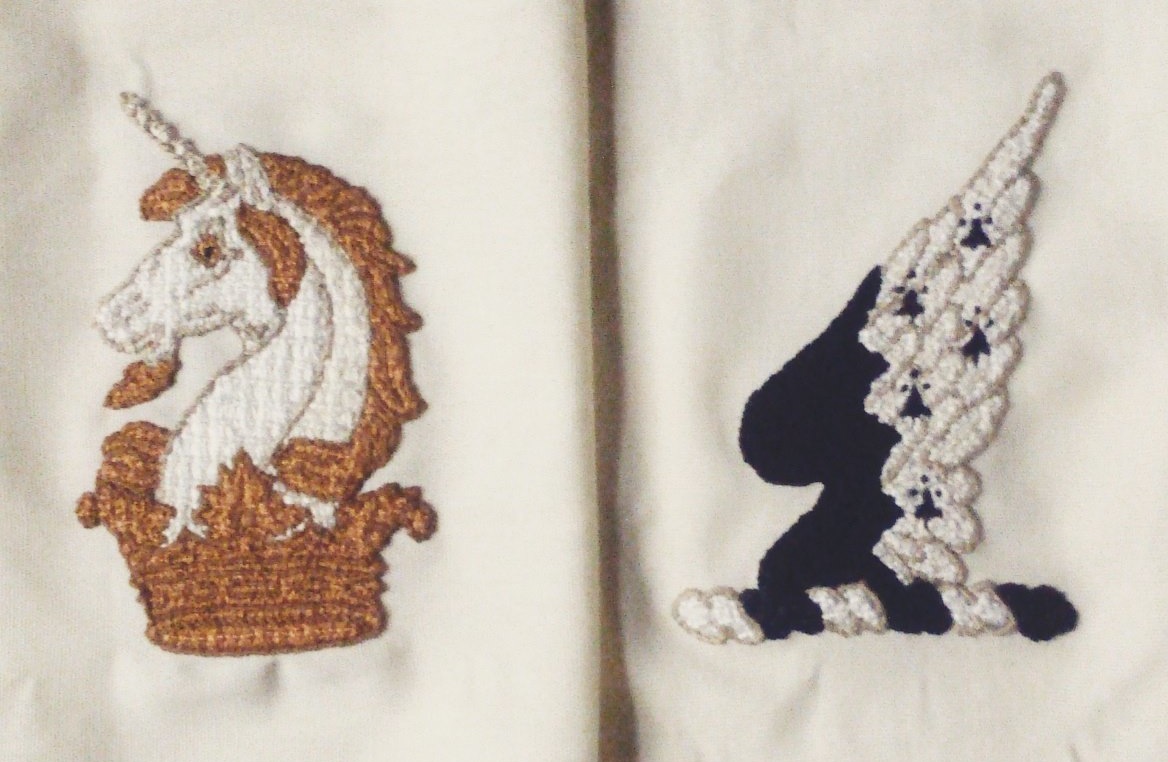
Finished! I have finished. Finally, my embroideries can sit side-by-side, ready for framing or for other kinds of presentation, looking smart and quite grand. Left, we have the Praed crest, a unicorn with crown; and right, we have the Mackworth crest, the raven’s wing and ermine. Traditionally, heraldry is interpreted right to left. Despite the stark colour difference between the two, I feel they go well together. This makes sense (as they are a considered pair), but I ensured that I used the same colours in my stitched interpretation wherever possible, whilst remaining true to the colour of the crests.

Usually it is the unicorn which is presented as the Mackworth-Praed sigil, as understandably, it is seen as the more prestigious of the two, but I am quite fond of the lesser-used raven’s wing, which seems to vary more due to liberal artistic interpretations. My interpretation is the more traditional presentation however, incorporating the pattern and colours also seen on the family’s coat of arms (which, by the way, will probably be my next craft related project).

As well as embroidering, this week I have been scanning slides taken in 1964 in Abisko, Sweden, by my grandfather. He was a keen conservationist and a great collector, collecting the moths and butterflies that he sought to conserve, and throughout his life he took many slides – around 22,000 of them. Some have come to me to digitalise, in the hopes that the National Trust may be interested in making use of them. It’s taken me four days to digitalise 200 slides – slides which (in these two boxes) consist of common to rare plants, reindeer hair, train stations and a dead lemming. These slides are all being stored on an external hard-drive, which I hope doesn’t crap out at one point or another because as of yet, I have no back up. Perhaps the thing to do would be to post up a few of the more interesting finds as I stumble across them – there are some lovely photos. The ones that interest me most, of course, are the photos of my family, particularly because the house that my father, aunts and uncles grew up in is also the home that I grew up in, too.

Before I scan 50 slides a day, I have been working on the illustrations for my children’s picture book. I thought I would share some sketches below (also viewable on my Instagram account):

dragon2 dragon1

They are, as you can hopefully see, dragons! There are ten of them, and they are all doing the sorts of things that dragons would do in a children’s book. The plan is to sketch them all in their various positions and then compile them for the final drawings – this is my first attempt at a picture book, after all, so I’m still finding my feet. I usually only do separate studies of one or two subjects at a time, but I have, at least, got a strong sense of the style in mind.

Other than that I’m still waiting for news from my proof readers, and resigning myself to the fact that I will probably have to read my book (again) on paper to check (again) for mistakes. If I find any, you’ll probably hear about it here. Until then, or until the next part-time post!
Blurb for The Future King: Logres

So! After blood, sweat and tears (not literally) I have finally completed my blurb for the back of my book jacket. Could I have a drumroll, please?

(Courtesy of http://freepercussionlessons.com/how-to-play-legato-drum-rolls-on-timpani/)

Here it is, my blurb for The Future King: Logres!

Britain, 2052. In a world of war, disease and hunger the UK stands alone as a beacon of prosperity under an all-powerful ruling party. Life at new school Logres seems promising for fifteen-year-old Gwenhwyfar, and quickly she falls for the school’s handsome catch, Arthur. When Arthur’s rival, Lancelot, returns after a suspension, her heart is immediately divided. Realising that behind the UK’s prosperity lies unspeakable cruelty, Gwenhwyfar sets off on a path to dismantle everything the government stands for. Suspenseful, raw and awash in a dystopian setting, The Future King: Logres is a story of identity and discovery against this backdrop, the second coming of the Arthurian legends.

The main thing is that it fits on my book jacket, right? Less is more, seems to be the resounding advice that I’ve collected from looking at various ‘how to’ sites. If anyone has any thoughts, please do share them. Meanwhile, whilst I’m waiting to hear back from my proof reader, I’m finishing off another project (a children’s book), which I’m hoping to release before Christmas. I won’t give away too many details just yet, but I’ve outlined the approach for the illustrations, and will hopefully be completing them (and posting updates) in the next few weeks. Exciting! (Well, it is for me.)

Progress on self-publishing!

sir-mador-s-spear-brake-all-to-pieces-but-the-other-s-spear-held

So! Yesterday (was it yesterday? Actually, I think it was Friday), I finished my edit/proof read of my novel. That’s right! All five-hundred and something pages checked, double-checked, and tweaked. Surprisingly the new format of the novel made catching things that I’d never noticed before much easier – such as missing speech marks, duplicated words, or words that had clearly hung on despite the rewriting of the sentence. Inevitably, I will have missed one or two things. My three-pronged approach of reading in my head, reading aloud, or getting dictation & speech to read for me can’t have picked up everything. As a result I have sent my final draft off to my proof-readers, and am awaiting their verdict. I shall have to resist the urge to edit again when comments come back – after all this is the start of a story, and there are always so many ways to tell it.

In the meantime I am trying to work my way through the minefield that is writing your own blurb. I should be able to manage it, I’ve written a novel, right? I edited that novel, then after that I did the unthinkable – I trimmed down 120,000 words into a one-page synopsis. That, at the time, seemed impossible – but as it is often shown, the impossible turned out to be possible after all. 200 words or less is a much shorter order to work to, however, and (so far) I’ve found it’s the sort of thing that can only be approached in short bursts.

One draft – a splurge of sentences on the page that make little sense. Break. Another draft, writing an alternative to the above. Research, lots of research – or at least just a little bit – looking at book blurbs in your own library and googling ‘how to write a book blurb’, only to find that there are several ways one can do it. Writing again, with these strict guidelines in mind. Deleting all the above because, surprisingly, the guidelines were actually quite helpful. Break, because what you wrote needs to sink in before you can edit it. But you’re there, you’ve got the tone and the content right. Now it just needs to… pop.

Other than that, my schedule at the moment includes getting other aspects right – in particular things like text for the acknowledgements. As I am destined to a reasonable wait before I can continue with the whole publishing thing (everything is on hold now until the book itself is ready to be uploaded), I will probably return to some of the other points on my to-do list for a while. Scanning my grandfathers’ slides of plants and butterflies is one, illustrating a few projects is another, working on a children’s book is my third (nearly done, I just need a decent ending). Presently I am battling the urge to try restructuring my book completely, just to see if it would be better (or worse). Knowing when to stop tweaking is a good skill, and it’s easier to do when working on a painting or drawing. The result of a drawing is usually completely visible on one page, and is therefore easier to conclude that it is, actually, finished. Perhaps someday I will be able to transfer such understanding to my written work, and the whole process may become a little easier to draw a line under.

10 things I have learned whilst proof reading

  1. Unless you are a professional proof reader, it is inevitable that you will always miss something (but then I wonder, do professional proof readers miss things too?).
  2. It is surprising how one can read a manuscript multiple times, catching double-spaces, incorrectly formatted dashes and dots, missing words, extra words, and yet on the hundredth read discover an entirely overlooked error – in my case missing speech marks at the end of some lines.
  3. Relying on speech & dictation to catch things for you is a very useful method (particularly for spotting typos) – but it is not to be relied upon 100%. Only yesterday my reader Alex decided to add ‘that’ into my sentence. Clearly he thought the sentence was better with an extra demonstrative pronoun.
  4. A formatted manuscript is much easier to spot mistakes in than a non-formatted manuscript. I suppose it’s the increased space between lines, the fewer words per page, or something.
  5. Fewer words per page and a smaller page size means that you’ll have twice as many pages to proof read, yet somehow because of this the whole task seems to go faster (120 pages per day! Woo!).
  6. Knowing when to stop proof reading is a real issue. How many times do you go through it? With each change lies the potential for fresh mistakes. What if you have a blind spot to the difference between her and his? You meant his, but you typed her. You might not see you typed her until your book is already in print.
  7. I suppose the above is why I am asking friends and family to read through my manuscript for me (trusting, of course, in their superior ability to sense typos in a sentence – much like those who sense a formidable, horrible disruption when one digit is off in pi – can you? 3.141592653589793238462643383279
    50288419716939937510582097494459230781640628620899862803482
    534211706798214808651328230664709384460955058223172535940812
    848111745028410270193852110555964462294895492038196442881097
    56659334461284756482337867831652712019091456485).
  8. The fear of releasing one of those books that we’ve all come across – when you’re on page seven, and a word is missing, or wrong, or repeated – is quite possibly irrational, but also very real.
  9. Don’t try to proof read if you’re tired or hungry. Unless you’re in the right frame of mind whilst reading, you will approach the end of the chapter with the feeling you have not done as well as you could have, and then resign yourself to combing through the same pages again later, when you’re feeling a little less useless.
  10. With all the above taken into consideration, a novel can always be amended to fix any overlooked errors. After all, we all know that’s what editions are really for, right?

10 things I have learned whilst making a book cover

  1. Pre-existing book covers are your friend. Look at them, examine them and focus on studying books in your genre, but don’t be too disappointed if your self-publishing platform doesn’t support the trim size you inevitably fall in love with as a result (five by seven, five by seven!).
  2. Make sure the cover correlates with the interior feel of the actual novel (and then dance about celebrating your own brilliance when you think of something that looks really cool).
  3. Having twenty layers live at once in Photoshop will destroy your computer. No, really. The fan on mine has just… died, or something.
  4. After spending four hours trying to align font at the bottom of your page to font at the top of your page, your eyes will go funny and everything will look wonky anyway.
  5. The longer you stare at the block colour red, the more it begins to look like some whacky gradient.
  6. Apparently due to variations in book binding the artwork for the cover will sometimes end up on the spine, and spine on the cover. You will be advised to avoid sharp lines and complex patterns, so naturally use them anyway.
  7. You should (and probably will) print out your book cover and wrap it around some other less important novel just to see what it looks like on a bookshelf (mighty good, I tell you).
  8. An actual, real life plastic ruler can be very helpful when determining layout spacing on your screen for the less technically gifted of us.
  9. Asking (non-graphic designery) people their opinion on your artwork can be confusing. Just focus on the things they agree on, and ignore anything they don’t.
  10. Making a book on a template before you have your final page count is just asking for trouble. You think you’re finished, then a last-minute cut adds or subtracts a page or two. New spine thickness, new document! Yeah!

What I’ve been up to

Today has been busy. Impatient to get some idea of what my book might look like once it is finished, I have been fiddling about with formatting in MS Word. With no clue where or what to start with, I found a very helpful website (http://www.diybookformats.com/mswordtemplates/) and have managed to set my margins, my paper size, choose a font, and even make chapter dividers in photoshop which match the feel of my draft design for my book cover. Being an arty person, I am very excited by this small achievement (it looks really cool).

Less encouraging is my page count. Yes, I know my final draft is not yet done, and having carved through about fifty pages today I am fairly certain that it will end up being about 20 A4 pages shorter than it is now. In my new layout however, the book as it is (140,000 words) is close to six-hundred (5.25 x 8) pages. I had assumed that publishing your own book might give you greater freedom concerning word count, but after doing Amazon’s royalty calculator I have discovered that my novel would cost me 50p per book to print in the UK. Not the 30-70% royalties I had in mind!

Before settling on the decision to self-publish I did approach the crowdsourcing website, Unbound. Set up by writers Dan Kieran, Justin Pollard and John Mitchinson, Unbound purports to let the readers decide which books get published through a process in which authors present pitches on Unbound’s website. These pitches then receive pledges (payments) from future readers. Only the pitches that reach their target (of about £15,000 from what I can tell from their FAQs [please do correct me if I am wrong]) get published.

It sounded perfect. But, of course, to avoid being swamped by endless pitches, Unbound do have a submissions process. Great for the works that make it through, but that means those works have (ironically) been chosen by the publisher. There is an eight-week wait to get to the top of the slush pile, so percentage-wise not many submissions seem to make it past the selection process (my pitch was one of them). Basically Unbound seems to be a publisher with the best of both worlds – no upfront costs to publish their chosen author’s works, because the readers (may or may not) cover that for them.

Crowd-funding in publishing still seems to be relatively new, and whilst exploring my options I did come across several other sites that seemed to adopt the same concept as Unbound, with the difference that any pitch is posted. So far however, these websites only seem to publish e-books with a much lower crowd-sourcing target (for one of these sites the target was £500 per book). Others claimed to be free, but with the surprise of pop up adverts in your novel when anyone reads it, and (let’s be honest) no author wants their masterpiece repeatedly interrupted by weight-loss ads.

Unbound was tempting for me, because at 50% royalties as well as a paid-for investment in your book concerning editing, book cover and proof-reading it sounded like the best deal. It’s worth a go if anyone out there hasn’t tried it already, particularly if you have a large social media following – it’s one of the things they ask you when you apply because the more followers you have the more books you’re likely to sell. It is discouraging to find that yet another creative endeavour essentially boils down to a popularity contest (or, you could argue, a large social network), but this is already endemic in many artistic fields and is hardly new. Followers = distribution = wider market = more sales. It is becoming the case in the fashion industry, with models with higher numbers of followers getting booked for bigger jobs. Free advertising makes perfect sense.

Ultimately, the author knows what will be a good fit for them, but unfortunately for us writers we’re not usually the ones who get to choose. I am excited about self-publishing though. It’s a challenge, a test to see if I can do it. Can I be editor, designer, agent and writer all at the same time? We’ll find out when it’s released. I’ve already announced my intention on Facebook, and though my social network is modest I’ve had encouraging feedback (and great encouragement). They’re probably just pleased that I’m finally taking the initiative to get it out there – I have been harassing them all with novel-related updates over the years.

I’m half-way through my revision. I caught a scene that referenced something that had already been resolved earlier in the book, so I think as editor I am doing well. I will post up artwork updates as I create them and closer to the release. In the words of most people everywhere, ‘let’s do this!’

The long haul.

When I first started my novel back in 2011, the first draft took me a total of six weeks. I had an idea I’d been chewing over since 2007 with one short attempt to turn it into something physical, but then, at the end of my university semester and with a long summer ahead of me, I dove in head-first and just wrote it.

How long is too long when working over an idea? Us artists are creatures of detail, and such proficiency bestows upon us great patience. Sometimes we get drawn into an idea too much, and find ourselves unwilling (or unable) to comprehend an end. Does such a predicament matter, however, when one is so engaged by an idea that it feels as if every day spent working on it is entirely new? Often it passes without notice; the minutes become hours, the hours whole days. You work, and you forget to eat, drink or sleep. You’re so enthralled by what you are doing that the pang of hunger or stiffness brought about by an uncomfortable chair can do nothing to hinder you.

I have done several drafts of my book up to date, and naturally each revision was packaged with the exclamation, ‘Eureka! This is it!’ and sent off to the most promising literary agents. Of course with each submission came a rejection, and I would soon succumb to the age-old problem of returning to your own work with eyes changed by time. It happened when I painstakingly drew Christopher Columbus’ ship when I was four. Then, it was a masterpiece! Now, not so much.

A novel, unlike a sketch or drawing however can be edited, and so I embarked on making it perfect. Each time shorter or longer, and every time (I would like to think) better, stronger. My very fast draft in 2011 was written with the estimate I would then spend about six months editing. Then it would be ready to publish. Of course.

Four years later I am on my… fourth? real, complete restructure and rewrite. I’ve read the blogs, I’ve seen the news. I know that most people’s first projects get shelved until they are rich or famous enough through other works to get them published retrospectively. Does it change things if I say that this isn’t my first attempt at a novel? My first idea has been shelved without much input, perhaps for another day.

I think, however, we all have some idea of what works and what doesn’t. We all read and we all have things which we can compare our own work to. My latest draft, I have decided, is going to be my last. I will make sure I am happy with it, and then I will move on. These days debut authors’ options are expanded by the possibility of self-publishing. Now our first novels can be released into the market as they are, as we intended.

This project is a series, or it will be when I’m done with it. After researching the available avenues self-publishing is becoming a real consideration. I have had interest for my idea from two reputable agents, including full manuscript requests and even one revise and resubmit. Unfortunately, it wasn’t for them. But I now have a better book as a result, and am less anxious about getting it out there without the traditional route and safety net of an editor or publisher.

I have half my novel left to edit, and then it’s back to proof-reading. Then I think I’ll take the plunge. I’ll let my first novel be one of the ones self-published as it is, and as I intended.

10 things I have learned whilst searching for a literary agent.

  1. The Artists and Writers Yearbook is a must, but with my copy harking from 2013, I have discovered the internet to be just as useful.
  2. At first you apply to three agencies simultaneously, having heard the stories. Then five at once. Then eight at a time. When you start to fear they may all reject you, you begin to wonder how long you should wait until starting from number one again.
  3. Time is slow when you have queries pending, which (assuming you adopt the above) is always.
  4. Checking your emails seven times a day does not make time go faster.
  5. A request for a full manuscript will always fill you with joy.
  6. A rejection after a request for a full manuscript amends your expectations to ‘best case’ and ‘worst case’ scenario. The ‘worst case’ scenario is that you will receive an unaccompanied ‘no’. The ‘best case’ scenario is that you will get some usable feedback.
  7. The gratitude you feel when you finally do get tailored feedback is boundless. Agents are busy, we all know, which makes this feedback all the more valuable when someone does find the time to give it to you (thank you, really).
  8. Rejections pass like unusually-shaped clouds. At first they are something to point out, but soon they go unnoticed.
  9. Silence from an agent after a query is no reflection on you, but on the time they have spare to respond. Don’t take it personally.
  10. Despite the above, finding an agent who loves your work as much as you do is still a viable and possible dream. Worrying about what to do should two agents ask to represent you may be premature, but it is an inevitable fantasy.