- Advertising works, even when you are not getting clicks. Spend sixty dollars on a Goodreads campaign and play with the text every now and then to test the traction. Link straight to your retailer page – you want people be directed to where they can buy your book. If they click, the fund goes down. If they don’t, they’re seeing the cover of your novel, even if they’re not directly looking at it. Thousands of people will see your book advertisement each month. Never underestimate the power of the familiar subconscious.
- Get on Goodreads. Without Goodreads my novel would be sitting sadly on Amazon, all alone, with two or three reviews. Granted, it only has six now but lots of people are seeing it through my regular giveaways and over 1,400 people have added it to their ‘to read’ list. That means something, right?
- With reference to the above, run regular giveaways. Just list one copy of your book, make the eligibility worldwide and let it run for a couple of months. Then when a winner is chosen put the next one up. It’s not exactly free advertising but it’s pretty cheap advertising – your book is being continuously advertised in the giveaway section. People’s friends will see when they enter thus spreading the word.
- Tweet! I do not Tweet nearly enough, but I try. If you’re doing giveaways or Kindle Countdown Deals let the users of social media know. Make a Facebook event, mention it in blogs, email group organisers on Goodreads and (responsibly) ‘spam’ the relevant folders in the forums. Just let readers know what’s happening, when; and share your excitement about your book as often as you can.
- It seems to be the thing for authors to follow five thousand people on Twitter in order to get five thousand people to follow them back. Except at some point they start to unfollow those five thousand people to make themselves look established. If they’re all doing it, it probably works, but it’s entirely false. Mostly they’re all just DMing each other asking one another to read their currently free book (yes, I know they’re probably selling more novels than me).
- Time is money, money is time. Do you have the money to splurge £500 on your latest advertising campaign? Can you pay for verified reviews from top reviewing/endorsement agencies? No? Do you have 36 hours a day to make the posters and find the reviewers/endorsers yourself? No? Do you have the money to get someone else to do it all for you instead?
- Promotion is time consuming and time spent not writing, but it works. 17 ratings on Goodreads may seem a low amount to most authors (shh, I’m going somewhere with this), but there are plenty of self-published (and agency-published) books out there that go their whole first year without. one. single. review. Oh, the horror.
- Visual aids help even the most learned of readers. Have a promotion? Then declare: FREE EBOOK! Now let’s try something more visual:
FREE EBOOK!
Slightly more eye-catching? no?
- Free ebook giveaways are better than discounted ebook sales. Whilst this is true for unknown authors like myself, someone like J. K. Rowling would probably benefit more from a discounted ebook giveaway bonanza. When I ran my Kindle Countdown deal with a discount on my novel, I achieved a grand total of 3 downloads. Better than none, obviously, and those people are probably more likely to leave a review. When I ran the free equivalent I got over 500 downloads. Have any of those people read my novel yet? There’s no way to tell. But it got me in the top five of the Arthurian books category for a couple of days at least (side note: Harry Potter is NOT ARTHURIAN!).
- Try to keep up with your social media appearances. Homely images of your novel next to coffee on Instagram will draw attention, or pen a declaration of how actively you are living the life of a writer. Share something like: New ideas for new scenes today. Writing from the heart, with a picture of you gazing out of a coffeeshop window. I haven’t tried it yet, but I see other people posting such stuff on Instagram and they get more likes than me, so they must be doing something right.
Tag: book
Untitled
So things have been busy lately. Not busy in the sense that I’ve got mountains of work done, am now half way through to publishing book two (or indeed that children’s book I was working on), but busy in the sense that real life has got in the way. New job, new home, and a new schedule that so far has left little time for anything else other than working and sitting in the sofa each evening, thinking about how much you should be doing with your evening time versus how little you are actually doing (LOTRO, I blame you).
That said, I have managed to get a couple of things done and will get back into the swing of working on projects evening and weekends soon enough. I’ve just organised another Goodreads Giveaway for the months of June and July and, feeling festive, have sorted out a Kindle Countdown Deal for the Spring Bank Holiday. Ironically in order to do this I’ve been shut inside fiddling with graphics and promotional material rather than actually sitting outside enjoying said spring weather, but so far I’m pleased with what I have planned. The phrases I’ve used to make the promotional posters come from the pages of my novel itself; lifted straight off of the New National propaganda posters that Arthur walks past on a regular basis.
“Smile and the world smiles with you, read one. A happy worker is a happy person, read another. You have the things in life you deserve, proclaimed the next. And, would you know if your neighbour is housing illegals?“
These posters will be released randomly in the run up to the Goodreads Giveaway I’ve organised, hopefully to rally up some excitement, so watch this space. In the meantime I’m hoping to break through book two syndrome, you know – something halfway between blank page syndrome and where the hell do I start syndrome. Don’t panic if you were expecting me to have already drafted book two by now – it’s all there, ready to go and planned on paper – I just want to start it right.
Except then I remembered that book two isn’t book two at all. I don’t need to worry about starting a new novel – it’s a series. And more specifically the second instalment of the series was always intended to be the second half of Logres, married entirely to Volume One. In fact, they’re not even separate: they should be the same book, just divided into two publications. Suddenly I don’t have to worry about new novel syndrome. Now I can just pick up where I left off – start a new chapter – without worrying about the final finished polished package.
Meanwhile I’ll keep working working, will adapt to my new routine and continue to anxiously await reviews from my read-to-reviewers, the people who are offering an honest review in exchange for a free copy of my novel. Yes, I now know I should have organised all of this before my release date way back in December last year, but I’m new at this book-writing book-promotion thing, and really I’m learning as I go along.
14 things… The Future King: Logres
With many thanks to Mlpmom (blogger, reviewer, and all-round nice person), I present to you my very first guest post: 14 things… The Future King: Logres, as hosted on Mlpmom’s amazing blog, My Guilty Obession!
14 things… The Future King: Logres
This looks like it is such a fun and interesting read and I can’t wait to get my hands on it.
Please do take a moment to visit My Guilty Obession to see what I’ve been up to. In my post I offer insight into what led me to the Arthurian Legends, how my characters first emerged and 14 things I learned whilst writing my debut novel. So check it out!
Want some links? Here are a couple:
My Guilty Obession (Mlpmom) on Amazon
Mlpmom (My Guilty Obession) on Goodreads
The Future King Logres is available to buy on Amazon!
Just click here.

Got to No.5 in Arthurian – and a tip or two!
So it’s over! My five day giveaway has come to an end, and downloading has gone quite well. Well enough for The Future King: Logres to shift up a spot and make it to number five in the free Arthurian charts on Amazon (see below)! Now that it’s no longer available for free, it’s been removed from the charts temporarily, and will probably be slotted back in much lower down until the paid sales start to trickle in.

Giving away your work for free isn’t something that is instinctive, and given the amount of work and time that goes into producing a self-published book it is compelling to have readers actually buy your book, especially after launch. You’ve got to earn back all those hours spent working for nothing but the love of your craft somehow. However, the reality is that a reader is more likely to give less for the work of a complete unknown than someone with an established track record, so despite any reservations I had it suddenly seemed instinctive to take the plunge and give my ebook away for free.
The whole five day thing worked out well (Amazon allows you to supply your ebook for free for a maximum of 5 days out of every 90 days), as it gave me time to build up momentum and get word around. Despite my modest social media following I managed to top 260 downloads, which quite honestly is many more than I was expecting.
If you’re in the same boat as me and you’re considering promoting your book (particularly if you’re about to or have just released it), then I would definitely recommend offering it for free for a short period. Obviously I’ve yet to see what number of reviews my giveaway will ultimately produce, but the more people who read an unknown book (and hopefully like it) the better – it should result in increased circulation and future sales.
If you are considering a free giveaway with zero budget I suggest the following:
- Prepare some eye-catching graphics that you can present across all your social media channels, a new one each day with a similar look and feel – sort of an e-flyer.
- If you have WordPress or a Facebook page, spend an afternoon preparing all your promo material and schedule your posts in advance – they’ll appear when you want them to and will give you more time on the day itself for actual book promotion.
- Ask your friends and family to reblog/share your posts to their friend networks – the more eyes that see your free ebook giveaway the better.
- Make use of the Goodreads website (or equivalent). I’ve only recently joined Goodreads myself, but there are thousands of members on there who are all looking for their next read – and they all appreciate a free book! Spend time posting in forums to build up your contacts, but more specifically look for groups that have specific threads where you’re encouraged to post news of your new book or free giveaway – I did this and it really helped circulate my ebook and gave me a boost on downloads.
- If you are on Goodreads you can create an event on your author page (good idea to set one up – just add your self-published book to the site, then declare that you are the author through your regular account – Goodreads will merge your account with your author account for you) and invite your friends. Send out as many invitations as you can, because the people you invite can also invite others to attend the event, maximising exposure.
- Don’t let things rest for too long. If you’re running your promo for multiple days, advertise, share and keep posting on every single one of those days. Don’t have a day off. Eventually your deal will get noticed by people outside of your regular friend sphere, and someone might be kind enough to share it.
- Make your offer very clear with exact start and end times, along with instructions on how use the offer. I found that a lot of people were having problems with the Amazon extensions. I was supplying a UK link, which meant that US or French customers couldn’t get the book for free because they were trying to make a purchase through the UK link. In the end I linked to those regions as well and detailed how to find the book when using a different Amazon site (you just change the site extension to your relevant region – e.g. .fr or .com).
Now that the free ebook promotion is over, I’m going to take a short break to a) apply to jobs, and b) continue with my other projects. Book promotion will have to be ongoing, but part of it is now a waiting game to see how those 260+ readers will take to TFK Logres and what sort of reviews they will leave (assuming everyone reads it!). I am hoping of course that they will love it enough to share it, but time will tell, so in the meantime I shall keep my head down and perhaps get back into writing book 2 instead.
Now to end with some more promotion as per my own advice. Though the 5 day deal has ended subscribers of Kindle Unlimited can still pick up TFK Logres for free, whilst it is now also listed at its regular price of £3.99. Still a steal for a 517 page book, no?
10 things I have learned whilst exporting to Kindle
- There are many more file types than I thought. .rtf, .htm, .epub… but it’s .mobi that you want. According to Amazon, .mobi is the one.
- Making your book available on Kindle isn’t as straightforward as it seems. A quick conversion of your .pdf, and then you’re done? So. I. thought.
- Actually, the above requires a) removing all formatting from your original Word document that you exported for print, b) keeping any formatting as simple as possible, c) exporting your Word document as a .htm/.html file, d) running said .htm file through a converter, e) downloading Amazon’s Kindle previewer, f) downloading Amazon’s Kindle reader because the previwer doesn’t preview well, g) realising that your document hasn’t exported quite as you would like and, h) running through all the former to try and suss out where you went wrong.
- Oh, and on top of that you’ll read all sorts of blogs and tips about what you shouldn’t do (i.e., forcing a certain font type on your text), but do them anyway, because firstly you don’t know how not to do it, and secondly ‘Normal style’ completely undermines any alternative fonts you have made use of in your book (who doesn’t like Garamond, anyway?).
- At several moments, in desperation, you will break from your formatting to look into companies and services which promise to do all the hard work for you.
- You will bemoan, ‘but I just want it to look like a book!’. Specifically your book, which you just spent months perfecting in print.
- It comes to your attention at some point that perhaps you should have sorted out your Kindle file first, before your book launch, but then you remember that Createspace and Amazon told you that it would be easy.
- Perhaps this is easy, you then think, as you export your book for the third time wondering why your TOC (that you made in Word, as you were told), still isn’t working. Why? Why?
- After downloading independent software to export your book to .mobi for you, you realise that it is the conversion itself that has broken your TOC, and that you could have just edited your .htm document in Dreamweaver in the first place to fix all the links and the formatting issues instead.
- You find random things in the block of your book text (like a hyphen between two paragraphs) and then think, God, has that always been there…? then don’t want to look to double check just in case it is (you’ll do it later, or forget, or a reader will find it for you).
The Future King: Logres, now available on Amazon!
Britain, 2052. In a world of war, disease and hunger the UK stands alone as a beacon of prosperity under an all-powerful ruling party. Life at new school Logres seems promising for fifteen-year-old Gwenhwyfar, and quickly she falls for the school’s handsome catch, Arthur. When Arthur’s rival, Lancelot, returns after a suspension, her heart is soon divided. Realising that behind the UK’s prosperity lies unspeakable cruelty, Gwenhwyfar sets off on a path to dismantle everything the government stands for. Suspenseful, raw and awash in a dystopian setting, The Future King: Logres is a story of identity and discovery against this backdrop, the second coming of the Arthurian legends.
The Future King: Logres: Volume 1

It’s out! It’s available to buy! Finally, after many hours of proofreading, formatting and double-triple checking my files, The Future King: Logres is live on Amazon (and also on Createspace). Soon to be released on Kindle, I thought I would share with you an extract from the middle of novel to whet your appetites.
She was knocked out of Arthur’s grasp in a second, pushed aside by one scrambling body and then another, and suddenly she was being carried along with a stream of faceless figures, fighting against them, trying to get back.
‘Arthur!’
A tear gas canister propelled past her, splitting the protestors. Someone pushed her hard in the back. Gwenhwyfar didn’t realise she had fallen until she was on the tarmac. Instinctively her hands flew up to protect her head. Someone trod on her leg, another person tripped over her stomach. The shouting was frightening. Grabbing hands pulled her up, and then another protestor was asking if she was all right, helping her away from the scene. When she fought against them they abandoned her.
‘Arthur!’ she yelled again, cutting through the crush. He was tall; she should be able to find him, and at the same time she half-hunted for Gavin, who was tallest. She daren’t jump to try and see better; if she did she would go down again, and this time she might not get back up.
She longed to take her mask off; it was hot and hard to breathe. They had been told to go to Marvin’s meet-up spot if one of them got separated, but with her phone at home she was scared to leave when she knew that Arthur was here somewhere, just a few feet away.
The crowd struggled the only way it could—back into itself. Gwenhwyfar waited, alone and small as the road around her cleared, but when the police charged in with handcuffs and batons she shrank away, knowing she shouldn’t linger. A sudden heat seemed to melt against her with the brightest of lights. Someone had thrown a Molotov cocktail.
Of course none of this would have been possible without the support of my family and friends, and I would like to take a moment to thank everyone who has already ordered The Future King: Logres and who have supported me throughout this process. If you do buy a copy then I encourage you to leave a review on Amazon – it will help others decide if this book is for them and I would love to hear your feedback!
With TFK published I can now concentrate on other endeavours, and hopefully also continue writing Book II which will be the next in The Future King series.

Dragons, unicorns and ravens
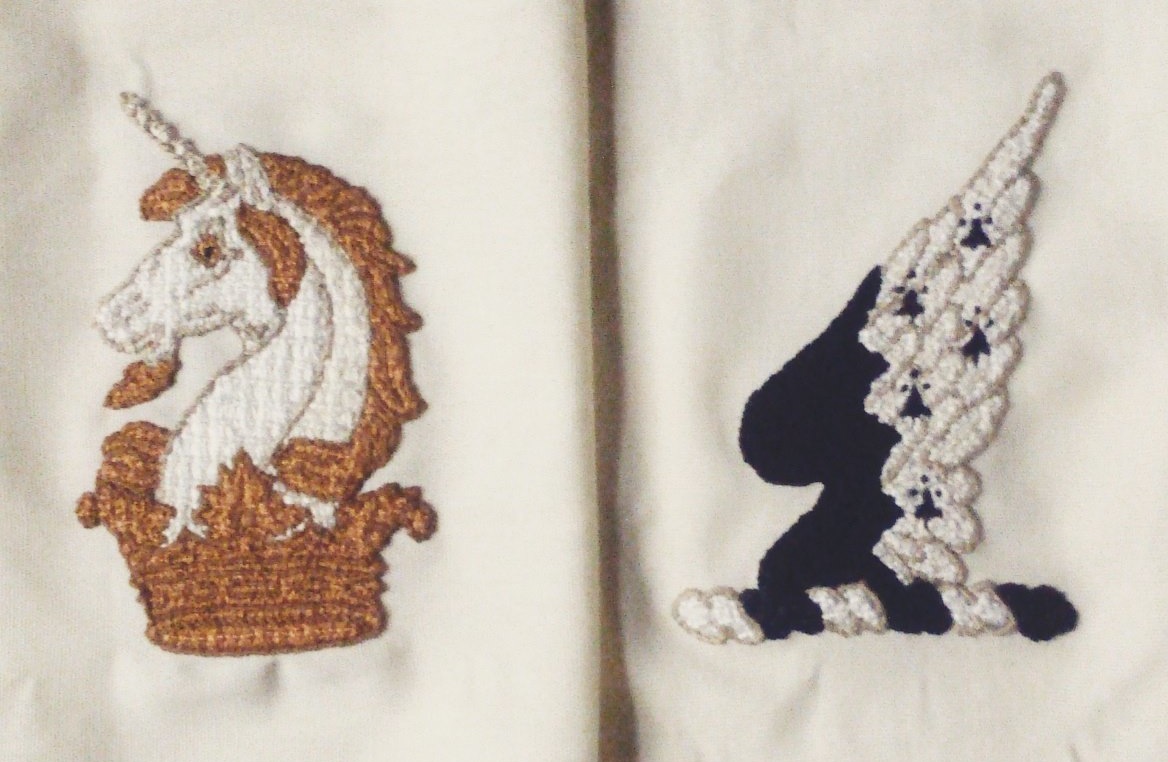
Finished! I have finished. Finally, my embroideries can sit side-by-side, ready for framing or for other kinds of presentation, looking smart and quite grand. Left, we have the Praed crest, a unicorn with crown; and right, we have the Mackworth crest, the raven’s wing and ermine. Traditionally, heraldry is interpreted right to left. Despite the stark colour difference between the two, I feel they go well together. This makes sense (as they are a considered pair), but I ensured that I used the same colours in my stitched interpretation wherever possible, whilst remaining true to the colour of the crests.
Usually it is the unicorn which is presented as the Mackworth-Praed sigil, as understandably, it is seen as the more prestigious of the two, but I am quite fond of the lesser-used raven’s wing, which seems to vary more due to liberal artistic interpretations. My interpretation is the more traditional presentation however, incorporating the pattern and colours also seen on the family’s coat of arms (which, by the way, will probably be my next craft related project).
As well as embroidering, this week I have been scanning slides taken in 1964 in Abisko, Sweden, by my grandfather. He was a keen conservationist and a great collector, collecting the moths and butterflies that he sought to conserve, and throughout his life he took many slides – around 22,000 of them. Some have come to me to digitalise, in the hopes that the National Trust may be interested in making use of them. It’s taken me four days to digitalise 200 slides – slides which (in these two boxes) consist of common to rare plants, reindeer hair, train stations and a dead lemming. These slides are all being stored on an external hard-drive, which I hope doesn’t crap out at one point or another because as of yet, I have no back up. Perhaps the thing to do would be to post up a few of the more interesting finds as I stumble across them – there are some lovely photos. The ones that interest me most, of course, are the photos of my family, particularly because the house that my father, aunts and uncles grew up in is also the home that I grew up in, too.
Before I scan 50 slides a day, I have been working on the illustrations for my children’s picture book. I thought I would share some sketches below (also viewable on my Instagram account):


They are, as you can hopefully see, dragons! There are ten of them, and they are all doing the sorts of things that dragons would do in a children’s book. The plan is to sketch them all in their various positions and then compile them for the final drawings – this is my first attempt at a picture book, after all, so I’m still finding my feet. I usually only do separate studies of one or two subjects at a time, but I have, at least, got a strong sense of the style in mind.
Other than that I’m still waiting for news from my proof readers, and resigning myself to the fact that I will probably have to read my book (again) on paper to check (again) for mistakes. If I find any, you’ll probably hear about it here. Until then, or until the next part-time post!
Blurb for The Future King: Logres
So! After blood, sweat and tears (not literally) I have finally completed my blurb for the back of my book jacket. Could I have a drumroll, please?
Here it is, my blurb for The Future King: Logres!
Britain, 2052. In a world of war, disease and hunger the UK stands alone as a beacon of prosperity under an all-powerful ruling party. Life at new school Logres seems promising for fifteen-year-old Gwenhwyfar, and quickly she falls for the school’s handsome catch, Arthur. When Arthur’s rival, Lancelot, returns after a suspension, her heart is immediately divided. Realising that behind the UK’s prosperity lies unspeakable cruelty, Gwenhwyfar sets off on a path to dismantle everything the government stands for. Suspenseful, raw and awash in a dystopian setting, The Future King: Logres is a story of identity and discovery against this backdrop, the second coming of the Arthurian legends.
The main thing is that it fits on my book jacket, right? Less is more, seems to be the resounding advice that I’ve collected from looking at various ‘how to’ sites. If anyone has any thoughts, please do share them. Meanwhile, whilst I’m waiting to hear back from my proof reader, I’m finishing off another project (a children’s book), which I’m hoping to release before Christmas. I won’t give away too many details just yet, but I’ve outlined the approach for the illustrations, and will hopefully be completing them (and posting updates) in the next few weeks. Exciting! (Well, it is for me.)

Progress on self-publishing!
So! Yesterday (was it yesterday? Actually, I think it was Friday), I finished my edit/proof read of my novel. That’s right! All five-hundred and something pages checked, double-checked, and tweaked. Surprisingly the new format of the novel made catching things that I’d never noticed before much easier – such as missing speech marks, duplicated words, or words that had clearly hung on despite the rewriting of the sentence. Inevitably, I will have missed one or two things. My three-pronged approach of reading in my head, reading aloud, or getting dictation & speech to read for me can’t have picked up everything. As a result I have sent my final draft off to my proof-readers, and am awaiting their verdict. I shall have to resist the urge to edit again when comments come back – after all this is the start of a story, and there are always so many ways to tell it.
In the meantime I am trying to work my way through the minefield that is writing your own blurb. I should be able to manage it, I’ve written a novel, right? I edited that novel, then after that I did the unthinkable – I trimmed down 120,000 words into a one-page synopsis. That, at the time, seemed impossible – but as it is often shown, the impossible turned out to be possible after all. 200 words or less is a much shorter order to work to, however, and (so far) I’ve found it’s the sort of thing that can only be approached in short bursts.
One draft – a splurge of sentences on the page that make little sense. Break. Another draft, writing an alternative to the above. Research, lots of research – or at least just a little bit – looking at book blurbs in your own library and googling ‘how to write a book blurb’, only to find that there are several ways one can do it. Writing again, with these strict guidelines in mind. Deleting all the above because, surprisingly, the guidelines were actually quite helpful. Break, because what you wrote needs to sink in before you can edit it. But you’re there, you’ve got the tone and the content right. Now it just needs to… pop.
Other than that, my schedule at the moment includes getting other aspects right – in particular things like text for the acknowledgements. As I am destined to a reasonable wait before I can continue with the whole publishing thing (everything is on hold now until the book itself is ready to be uploaded), I will probably return to some of the other points on my to-do list for a while. Scanning my grandfathers’ slides of plants and butterflies is one, illustrating a few projects is another, working on a children’s book is my third (nearly done, I just need a decent ending). Presently I am battling the urge to try restructuring my book completely, just to see if it would be better (or worse). Knowing when to stop tweaking is a good skill, and it’s easier to do when working on a painting or drawing. The result of a drawing is usually completely visible on one page, and is therefore easier to conclude that it is, actually, finished. Perhaps someday I will be able to transfer such understanding to my written work, and the whole process may become a little easier to draw a line under.
10 things I have learned whilst proof reading
- Unless you are a professional proof reader, it is inevitable that you will always miss something (but then I wonder, do professional proof readers miss things too?).
- It is surprising how one can read a manuscript multiple times, catching double-spaces, incorrectly formatted dashes and dots, missing words, extra words, and yet on the hundredth read discover an entirely overlooked error – in my case missing speech marks at the end of some lines.
- Relying on speech & dictation to catch things for you is a very useful method (particularly for spotting typos) – but it is not to be relied upon 100%. Only yesterday my reader Alex decided to add ‘that’ into my sentence. Clearly he thought the sentence was better with an extra demonstrative pronoun.
- A formatted manuscript is much easier to spot mistakes in than a non-formatted manuscript. I suppose it’s the increased space between lines, the fewer words per page, or something.
- Fewer words per page and a smaller page size means that you’ll have twice as many pages to proof read, yet somehow because of this the whole task seems to go faster (120 pages per day! Woo!).
- Knowing when to stop proof reading is a real issue. How many times do you go through it? With each change lies the potential for fresh mistakes. What if you have a blind spot to the difference between her and his? You meant his, but you typed her. You might not see you typed her until your book is already in print.
- I suppose the above is why I am asking friends and family to read through my manuscript for me (trusting, of course, in their superior ability to sense typos in a sentence – much like those who sense a formidable, horrible disruption when one digit is off in pi – can you? 3.141592653589793238462643383279
50288419716939937510582097494459230781640628620899862803482
534211706798214808651328230664709384460955058223172535940812
848111745028410270193852110555964462294895492038196442881097
56659334461284756482337867831652712019091456485). - The fear of releasing one of those books that we’ve all come across – when you’re on page seven, and a word is missing, or wrong, or repeated – is quite possibly irrational, but also very real.
- Don’t try to proof read if you’re tired or hungry. Unless you’re in the right frame of mind whilst reading, you will approach the end of the chapter with the feeling you have not done as well as you could have, and then resign yourself to combing through the same pages again later, when you’re feeling a little less useless.
- With all the above taken into consideration, a novel can always be amended to fix any overlooked errors. After all, we all know that’s what editions are really for, right?
 M. L. Mackworth-Praed